

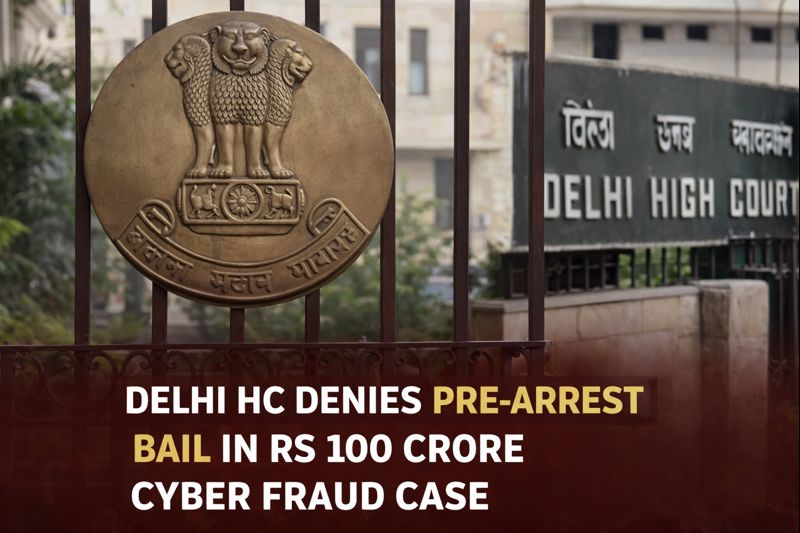
High Court Rejects Anticipatory Bail for Two Chartered Accountants The Delhi High Court on Monday rejected anticipatory bail applications filed by two Chartered Accountants in connection with a major cyber fraud and money laundering case involving transactions exceeding Rs 100 crore. Justice Girish Kathpalia emphasized that custodial interrogation was essential to uncover the full scale
High Court Rejects Anticipatory Bail for Two Chartered Accountants
The Delhi High Court on Monday rejected anticipatory bail applications filed by two Chartered Accountants in connection with a major cyber fraud and money laundering case involving transactions exceeding Rs 100 crore. Justice Girish Kathpalia emphasized that custodial interrogation was essential to uncover the full scale of the alleged offences.
The accused, Bhaskar Yadav and Ashok Kumar Sharma, were denied pre-arrest bail as they failed to meet the mandatory “twin conditions” under Section 45 of the Prevention of Money Laundering Act (PMLA). The court found no reasonable grounds to believe that the accused were not involved in money laundering or that they would refrain from committing further offences if granted bail.
Background of the Case
The case arises from a prosecution complaint filed by the Enforcement Directorate (ED) following investigations into multiple FIRs related to cyber frauds, investment scams, and job-related frauds.
According to the ED, an organised criminal syndicate with international links allegedly defrauded victims and laundered proceeds through thousands of bank accounts before transferring funds abroad and converting them into digital assets.
Investigators reportedly identified thousands of suspicious bank accounts across India, used to layer and conceal illicit funds through debit cards, overseas withdrawals, and online platforms. This suggested a complex, multi-layered money laundering network.
Court Observations on Money Laundering Allegations
The High Court rejected the defence claim that the case involved only legal digital asset transactions, noting that the evidence pointed to a “vast and intricate web” of money laundering.
The accused were allegedly part of a Delhi-based group controlling numerous accounts and entities to channel and hide tainted funds. Analysis revealed that dozens of bank accounts linked to a small number of mobile numbers collectively routed nearly Rs 100 crore overseas, with over Rs 65 crore connected to the accounts operated by the applicants.
The court also highlighted that the accused allegedly operated at multiple levels of the laundering chain, including direct receipt of funds from foreign actors.
Enforcement Directorate’s Position
Represented by Advocates Anurag Jain, Vivek Gurnani, Kanishk Maurya, and Satyam Prakash, the ED opposed the bail pleas, arguing that custodial interrogation was crucial.
The agency claimed that the accused had allegedly:
-
Destroyed electronic evidence
-
Wiped digital devices
-
Assaulted enforcement officials during searches
-
Bribed local police to settle cyber fraud complaints
These actions, the ED argued, posed a serious risk to the ongoing investigation if pre-arrest protection were granted.
High Court Rejects Parity Plea
The accused also sought bail on the grounds of parity with co-accused who had obtained regular bail. The court rejected this claim, stating that those cases were factually different and did not involve a request for custodial interrogation.
Justice Kathpalia held that the rigours of Section 45 PMLA applied fully, and thus both anticipatory bail applications were dismissed, allowing the ED to proceed with custodial interrogation as part of the ongoing investigation.
Significance of the Ruling
This ruling underscores the seriousness of cyber fraud and money laundering cases in India, particularly those involving large-scale digital transactions and cross-border financial networks. Authorities continue to monitor suspected fraudulent accounts and take strict action against organised criminal syndicates to protect public and investor interests.
















Leave a Comment
Your email address will not be published. Required fields are marked with *